USDA Construction Loan


A USDA construction loan can help eligible buyers build a home in a qualifying rural area with no down payment. Instead of using separate financing for the land, construction phase, and permanent mortgage, borrowers may be able to use a single USDA-backed loan for the entire process.
The USDA’s official name for this loan option is a Single Close Construction-to-Permanent loan, often referred to as a single-close, one-time close, or construction-to-permanent USDA loan. This guide explains how the program works, what costs it may cover, the main eligibility rules, and the steps that can help buyers get started.
A USDA construction loan is a USDA-backed mortgage for eligible borrowers who want to build a new primary residence in a USDA qualifying rural area. Depending on the loan structure and lender guidelines, the financing may include the land, construction costs, and certain related expenses.
| Stage | What Happens |
|---|---|
| Before Closing | The lender reviews borrower eligibility, the rural location, plans and specs, the builder, and the fixed-price construction contract |
| Closing | The borrower closes once on the construction-to-permanent loan, and eligible land and closing costs may be funded at that time |
| Construction | The lender manages draws from the construction holdback as work is completed and documented |
| Completion | The lender collects final documentation, which may include inspections, a certificate of occupancy, title updates, and warranty items |
| Permanent Mortgage | The loan continues as the permanent mortgage, with payment terms based on the loan structure used |
Check Your USDA Loan Eligibility with a USDA Loan Specialist
At closing, funds may be disbursed for the land and eligible closing costs, subject to program limits. The remaining loan funds are typically held in a construction holdback account and released in draws as work is completed and documented.
The interest rate must be fixed during construction. Depending on the loan structure, borrowers may make interest-only payments during construction or full monthly mortgage payments, sometimes funded through reserves built into the loan when allowed.
Once construction is complete, the loan moves into the permanent mortgage phase. Depending on how the loan is structured, that may involve re-amortization or a modification, while other setups may move directly into regular repayment.
USDA construction loan funds may cover reasonable and customary costs needed to complete the home, subject to lender review, appraised value, and program limits. Eligible costs can include:
Most USDA construction loan requirements are similar to those for other USDA loan types. You generally must:
USDA construction loans also have a few additional requirements because you are building a home rather than buying an existing one. You will need to:
A USDA construction loan is generally designed for borrowers who want to build a new single-family primary residence in an eligible rural area. That may include a site-built home, modular home, or eligible manufactured home, as long as the property meets USDA rules and lender requirements. The home must be used as a primary residence and cannot be primarily intended for rental income.
A property with a single ADU may be eligible in some cases, but that usually depends on whether the property still meets USDA’s single-family and owner-occupancy standards. Borrowers considering this setup should discuss the plans with a USDA-approved lender early in the process.
If you already own the land, a USDA construction loan may be able to pay off an existing land loan balance. But it generally does not allow cashback on land already owned free and clear.
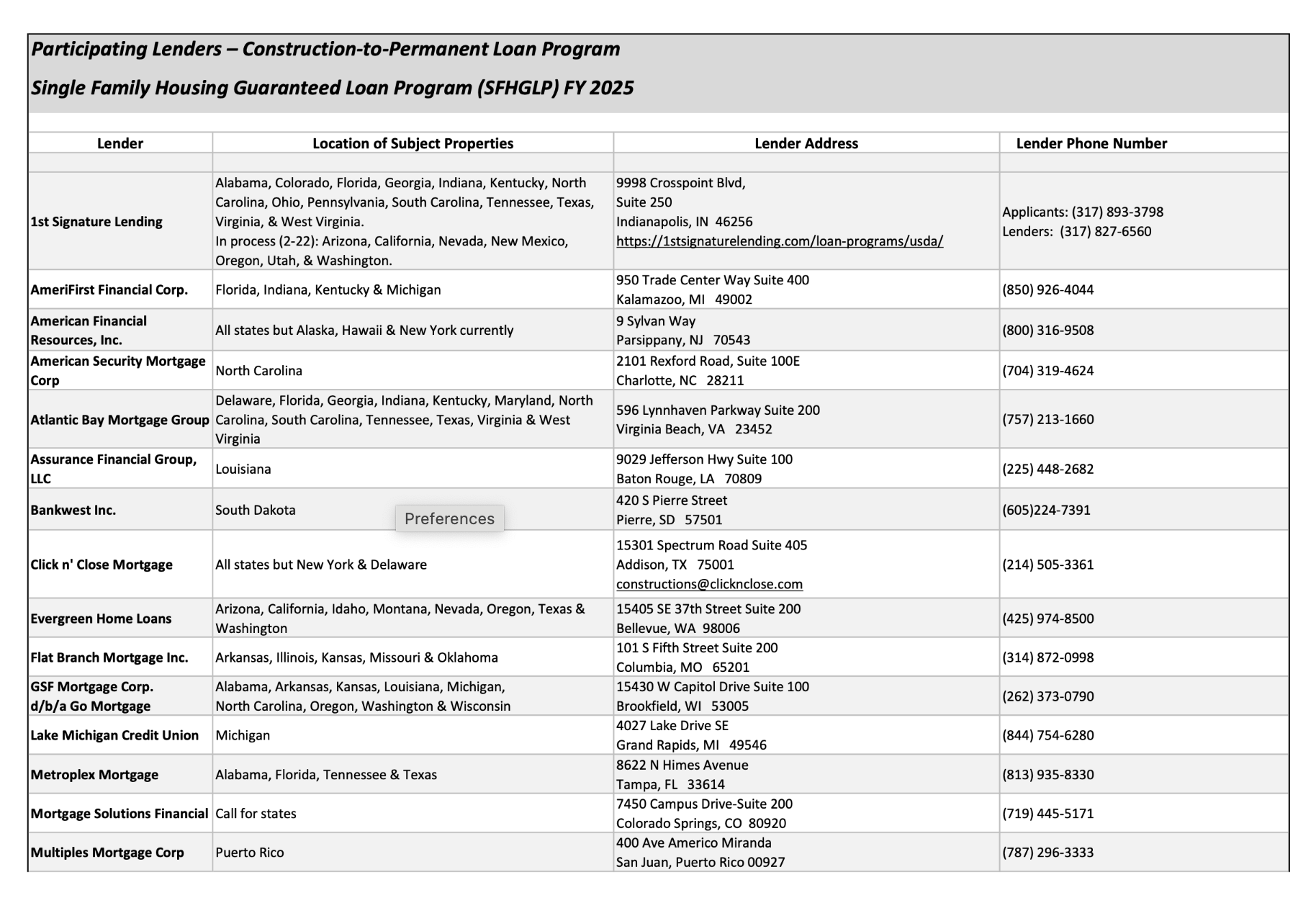
Not every USDA lender offers USDA construction loans, so one of the first steps is finding a lender that participates in the USDA Single Close Construction-to-Permanent Loan program. Below is the official USDA list of participating lenders:
For a USDA construction loan, borrowers generally need to work with a builder approved by the lender for the program. The lender reviews the builder’s experience and documentation before the loan closes.
Builders typically need to show:
It is also important to know that owner-builders are generally not eligible for USDA construction loan financing. Since USDA construction loans allow no-down-payment financing, the USDA requires approved contractors to ensure the home is built properly and within budget. Working with an experienced and USDA-compliant builder reduces risk for both the borrower and the lender.
If you're considering a USDA single-close construction loan, here are the steps you should follow to increase your chances of approval and ensure a smooth experience.
The first step is to find lenders that offer USDA construction loans. Compare the services, USDA construction loan interest rates, and fees from several lenders to find the best match for your financial situation.
A lender can review income, debts, credit profile, and basic eligibility to estimate affordability and flag any issues early.
The homesite must be in a USDA-eligible rural area. Borrowers can use USDA’s eligibility tools to check an address or general location.
Visit our interactive USDA eligibility map to help determine if your area meets the rural requirement.
Before closing, the lender generally needs to review the builder, the contract, the plans, and the construction details. Choosing a qualified builder early can make the process smoother.
The lender typically needs a fixed-price construction contract, detailed plans, specifications, a cost breakdown, and a timeline. The appraisal is usually based on the home’s expected completed value.
With a USDA one-time close construction loan, the borrower closes once before construction starts. After that, the lender manages the draw process, and the loan transitions to the permanent phase once construction is complete.
A USDA construction loan may be a good fit for eligible buyers who want to build a new primary residence in a qualifying rural area and prefer the simplicity of one loan and one closing. But lender availability, builder approval requirements and construction timelines can vary, so it’s a good idea to discuss the process with a USDA-approved lender.
If you are interested in a USDA Single Close Construction-to-Permanent loan, the next step is talking with a USDA loan specialist who can walk you through your options and help you get started.